
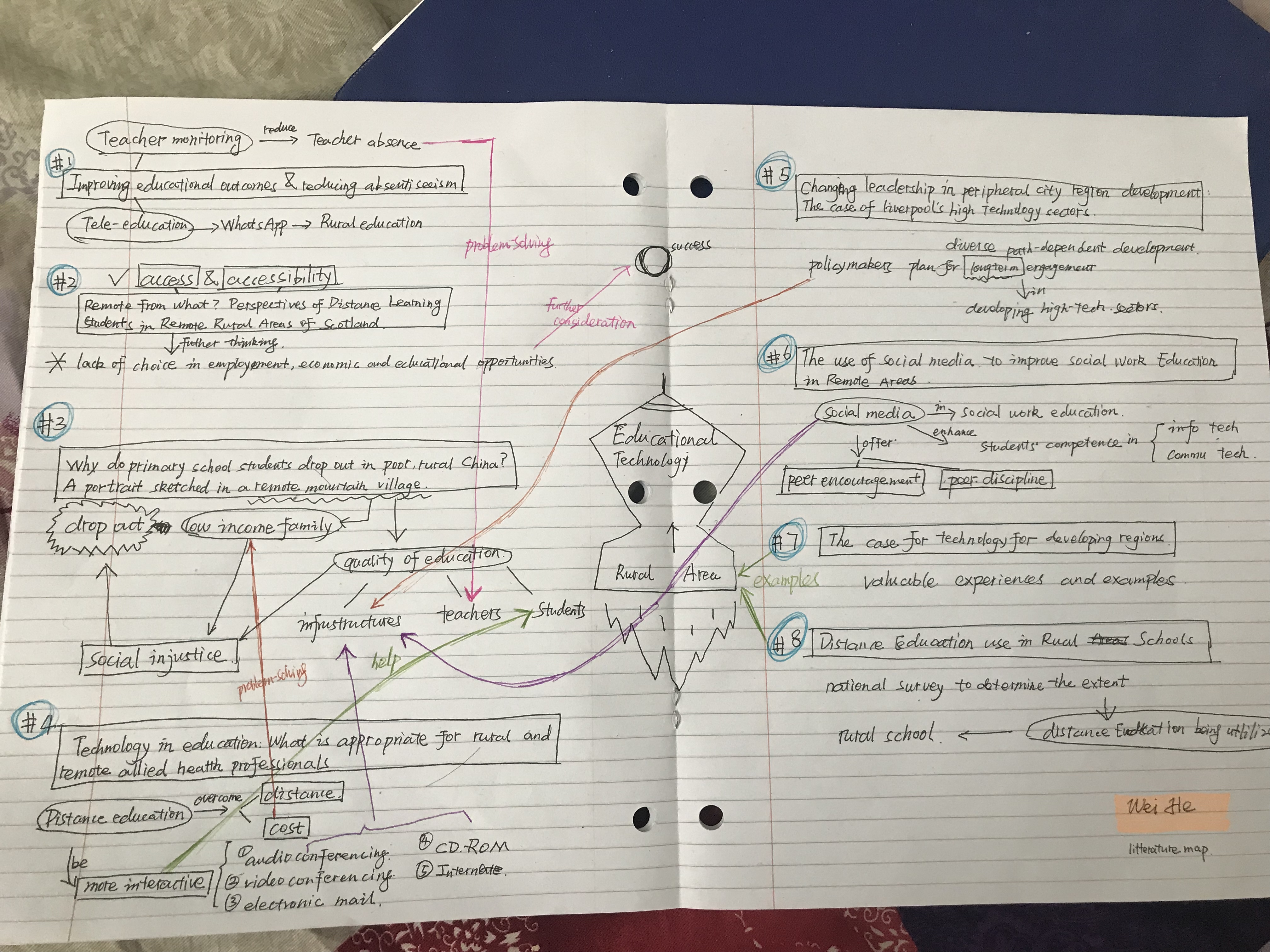
Literature Map
# 1
Hannum, W. H., Irvin, M. J., Banks, J. B., & Farmer, T. W. (2009). Distance education use in rural schools. Journal of Research in Rural Education (Online), 24(3), 1.
This article is about that a national survey of rural school systems in the United States was conducted to determine the extent to which distance education is being utilized by rural schools, the technologies used, the curriculum areas impacted, the perceived needs for distance education, their satisfaction with distance education, and the barriers to distance education use. Data were collected through telephone surveys with 394 school districts selected at random. This research also finds that the two most common formats for distance education courses in rural schools were two-way video conferencing courses and online courses. In addition, implications for future research are discussed. As the author mentioned, this study is limited by the sample and the participants who completed the telephone survey and supplied data.
I can learn from the case and experience of developed countries by referring to this document. Developed countries like the United States and Canada have their own unique characteristics in remote areas. By learning successful cases, I believe this has great guiding significance for me to think about how to develop education in rural China. That is the reason why I choose this research as one of my references.
#2
Kilpeläinen, A., Päykkönen, K., & Sankala, J. (2011). The use of social media to improve social work education in remote areas. Journal of Technology in Human Services, 29(1), 1-12. doi:10.1080/15228835.2011.572609
In this article, the authors describe an experiment to use social media in social work education. The use of social media and other distance-learning solutions, gives several advantages to both students and teachers. For example, it makes studying processes transparent, offers both peer encouragement and peer discipline, and enhances students’ competence in information and communication technologies (ICT).
I personally feel that the shortcoming of this paper is that the author did not compare the influence of the media on education in developed and underdeveloped regions; however, what is valuable is that in this article there are many crucial supporting outcomes arising from the use of social media in social work learning and teaching, especially in remote areas. Therefore, this article provides me with ideas for using social media technologies to improve and improve education in remote areas.
# 3
Nedungadi, P., Mulki, K., & Raman, R. (2018). Improving educational outcomes & reducing absenteeism at remote villages with mobile technology and WhatsAPP: Findings from rural india. Education and Information Technologies, 23(1), 113-127. doi:10.1007/s10639-017-9588-z
This study investigated how implementation of two simple, accessible technologies could not only reduce absenteeism but also increase teachers’ effectiveness and improve student performance. In addition to students and teachers, key stakeholders included educational coordinators who provided support and monitoring regarding use of WhatsApp and two additional apps designed specifically to support simple educational improvements.
Although the shortcoming of this survey is the insufficient number of participants, this survey still provides a reference for my research on how to improve the quality of education in rural areas. Additionally, the model mentioned in this article functions well in rural settings where there is poor internet connectivity and lack of supporting infrastructure. Remote schools can easily adopt this tablet-based model to reduce teacher absenteeism, improve teaching techniques, improve educational resources, and increase student performance.
In general, this article has certain reference value for my research.
Please see below the reading list I will go ahead with. Certain changes would apply if necessary.
I am interested in the question about how to use educational technology to improve the learning conditions in rural areas.
when I was doing the course reading, in the article Toward a sociology of educational technology, the author mentioned in the sociology-of-groups part the differences among different social groups, from which my thought about bridging the gap between the real area and the urban by using educational technology sparkled out.
In some underdeveloped regions in China, especially in rural areas, the quality of education is relatively inferior to that of developed areas. This unfairness caused by geographical disparity shows a deteriorating trend during recent years. But the more optimistic point is that the Internet penetration rate in rural China is rising. So I am thinking about whether we can help children in these areas by using new educational techniques. For example, in the remote areas, due to poor economic development and imperfect infrastructure, many excellent teachers will not choose to work in these areas. Therefore, from the perspective of teacher resources, children in remote areas are at a disadvantage. But if they learn from distance education on computers and teachers in relatively developed regions, they can enjoy excellent educational resources as well.
In this way, we can narrow the education gap between urban and rural areas.
After finishing the first assignment, I find that the sociology-related reading material quit meaningful. Especially when I read about the minority part of this article. The author told us some facts about different social classes in relation to educational technology. This point sparks my thoughts linking to the question – how to use educational technology to improve the teaching condition in rural areas in China, because educational gap between developed and underdeveloped areas is a hot issue that has been discussed during recent years.
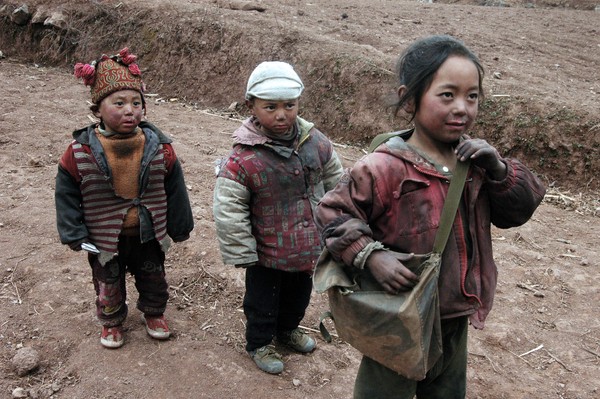
In China, the coastal areas which are the eastern part of mainland China are the most advanced in terms of many educational aspects, such as the infrastructures in school, the quality of teaching staff and the accessibility to resources ; however, the kids living in sub-developed regions are not lucky enough compared with the former, because these far-away-from-sea districts are mostly mountainous; thus up-to-date information is hard to be guaranteed.
Although there is a huge geographical difference between the west and the east, which also leads to a disparity in educational field, I do believe that we, as educators, are able to manage to bridge this gap, so I prefer to pay more attention to this field in educational technology.
Thanks for joining me!
Good company in a journey makes the way seem shorter. — Izaak Walton

 Wei He's blog